When students, parents, and educators alike hear the word "standardized" most think of a fill-in-the-ovals multiple-choice test that is viewed as a judgement of a student's academic worth. Though standardized tests have become a staple of U.S. education, they are neither the end, nor the means, of standards in education. The education reform of the past twenty years in the U.S. has sought not to implement standardized tests, but to ensure a standard education is accessible to all students everywhere. A standard, such as the gold standard in currency, is merely a frame of reference for comparison. It is an established norm against which other things of similar form can be equitably compared. In the case of currency, paper money was manufactured and could hold any denomination of the maker's choosing; however, comparing currency to a designated amount of gold ensured that a similar amount of paper or coin would always be the same no matter where it was tendered. For education, a set of curriculum standards assures that students are learning the same content in the same way, but necessarily with the same lessons. The idea is to ensure students all achieve the same academic end from their education independent of the instructional means. More simply, standards-based education is an agreed upon doctrine of what to teach and not how to teach.
The idea of standards in education is nothing new. The
Society of Jesus, e.g., the Jesuits, back in the late 16th century
created a document called the RatioStudiorum. That document served as a set of standards that defined what teaching
and learning would look like at all of their Jesuit schools around the world.
Montessori schools followed a similar effort in standardizing education in the
late 19th century. The purpose of standards for the Jesuits and Montessori
was, and is still to this day for all standards-based schools, to ensure that
all students are getting a similar educational experience in what they are
taught.
U.S.
schools began to undergo widespread standardization in the 1990s an effort to
respond to a 1980s report that the U.S. schools were falling behind those of
other countries. This process underwent three major iterations: America 2000 (George H. W. Bush
administration,) Goals 2000 (Bill
Clinton administration,) and in 2001 the most recent No Child Left Behind Act (NCLB) of George W. Bush’s administration
was adopted. Following from inspiration overseas in France and Great Britain,
the U.S. NCLB Act sought to ensure that all students were receiving a high
quality education in public schools by highly qualified teachers. School
performance would be measured on students’ success on standardized tests, and
the results of student testing would be reported to serve as basis for school
improvement. Ultimately, the nature of the NCLB Act, and standards-based
education in general, is well intentioned and seeks to provide all students a
great education.
The
education reform of the standards-based movement in the U.S. seeks to provide
more detailed feedback on student, teacher, and school performance to all the
stakeholders. This can better inform decision-making practices from all areas
of a school district and community. Additionally, at a larger scale, regional,
state, and national results from performance with standardized education can be
used to inform policy and funding decisions. All around, the intention of
standards-based education seeks to provide more information to help everyone
involved in students’ education to do the best that they can.
An approach to instruction, assessment and grading known as the standards-based learning approach can help all parties involved in a student's education achieve success. By outlining what the learning objectives are for students, e.g., standards, and designing instruction to help students reach those learning outcomes, students can be guaranteed to get a standard education anywhere. Traditional grading, however, does not provide quite the right amount of feedback for students, parents, and teachers about a student's performance with those content standards. When you think of a grade of "C," "B+" or "A," it may mean different things in different places to different individuals. This necessitates an assessment system that directly measures student performance with the learning objectives, but also a grading schema that gives more detailed feedback about the level of mastery a student has achieved with the content. In this way, external behaviors and any non-assessments of learning are removed from the grade, thus a student's grade in a standards-based system can more accurately reflect what they know.
Just as schools need more detailed
feedback on their students’ performance to improve their teaching practice,
students at the classroom or individual level need more detailed information on
their own performance to improve their learning. Standards-based assessment and
reporting is a reliable and effective means of obtaining and communicating
meaningful feedback about student learning. It helps to keep students focused
on learning and makes their own learning more transparent, accessible and
attainable. With the right feedback, students can be empowered, just as
educators are by data, to self-reflect, change and improve. Ultimately,
implementing a standards-based approach at the classroom level can positively
impact schools in a trickle-up manner. Students begin to connect what they
learn with success and not merely what they do. This leads students to become
better self-advocates, develop a growth mindset toward their own education, and
work with educators to be more successful.
Four years ago, I was introduced to the Modeling Method for teaching physics at Arizona State University. It instantly clicked with my constructivist philosophy of teaching & learning. It helped make me an excellent physics teacher who challenged students to think more than ever and taught science by doing science. Last year, I had the opportunity to travel to Pennsylvania to train in the Modeling Method for teaching chemistry. Another influential experience, this program transformed my chemistry instruction and helped align my teaching philosophy and pedagogy with both of the science disciplines that I teach.
In my experience with teaching using the Modeling Method, I have had tremendous success making learning of science accessible, engaging and challenging to all levels of high school students. This post is a resource for anyone interested in the Modeling Instruction in Chemistry program. The training is done over a three-week period of 15 full-day course meetings. A total of over 100 hours of contact time wherein the participants in the training will go through all of the curriculum in the role of the student and debrief and discuss the underpinnings of it all as teachers.
Modeling instruction is a constructivist pedagogy for teaching science using inquiry-based methods. Though it could be translated to other disciplines, it is a framework for teaching wherein learning takes place through the focused development and deployment of conceptual models. The models are constructed by the students themselves through the active experiences of interacting with the the content in a physical context. The teacher's role is to guide students and cultivate their learning with them. Multiple representations of the developed models are a mainstay of this approach.
The curriculum design for Modeling Instruction in Chemistry was influenced by the CHEM-Study approach which first appeared in the early 1960s. This approach to chemistry instruction makes the particle models used to describe matter and the treatment of the role of energy in change more explicit. The three essential questions that guide this approach to chemistry teaching & learning are:
How do we view matter? (Answer in terms of the particle you are using to describe matter)
How does matter behave? (Provide an explanation of the behavior using this particle model)
What is the role of energy in the changes we observe?
The curriculum framework for Modeling Instruction in Chemistry is comprised of nine essential units, each of which contributes additional features to the ever-developing model of matter. It follows a generally historical perspective of the development of the body of knowledge in chemistry that exists today, and it makes the structure of the discipline far more explicit than any other conventional approach to teaching chemistry. The nine units are highlighted below along with a more detailed entry about the units in the context of the three-week training.
Unit 1 - Physical Properties of Matter Matter is composed of featureless spheres (particles) which have mass and volume. Unit 2 - Energy & States of Matter (Part I) The particles are in constant, random, thermal motion.
Unit 3 - Energy & States of Matter (Part II) Energy is a conserved substance-like quantity that is stored in various accounts and transferred in various ways.
Unit 4 - Describing Substances, Mixtures and Compounds The particles that make up substances can be compounded from smaller particles.
Unit 5 - Counting Particles Too Small to See Using Avogadro’s Hypothesis we are able to determine the number of molecules in macroscopic samples by weighing them.
Unit 6 - Particles Having Internal Structure We find that atoms have the property of charge and some internal structure
Unit 7 - Chemical Reactions: Particles and Energy Chemical reactions involve the rearrangement of atoms in molecules to form new molecules.
Unit 8 - Stoichiometry Equations representing chemical reactions relate numbers of particles (molecules or formula units) to weighable amounts of these particles.
Unit 9 - Applications of Stoichiometry Equations representing chemical reactions can also relate numbers of particles (molecules or formula units) to volumes of gases, solutions and to the change in chemical potential energy.
The entire Modeling Chemistry Workshop was documented and chronicled during summer 2012 in a series of 18 posts, each of which focuses on topics from one or more of the units of study:
This past week was the 2012 Michigan Digital Learning Conference hosted by the MACUL organization. The conference brings together Michigan educators and technology professionals to share ideas on what the latest and greatest in technology could mean for education. There were presentations by classroom teachers, administrators, tech "gurus" and technology vendors. The conference was an opportunity to learn new things, share and discuss ideas with others from around the state of Michigan, and to renew a sense of the role of technology in our lives. There was something for everyone to take away from the keynote, session presentations, and discussions. Whether you are in the field of education, or just want some great digital ideas to use in your personal or professional life, here are the top ideas that stood out at the conference.
LeapMotion Keynote speaker Leslie Fisher presented on day two of the conference and showcased a number of cool gadget tools and apps for iOS. LeapMotion, an up-and-coming competitor to Microsoft's Kinect, promises 0.01mm accuracy hands-free control of a device. The device will allow you to use gestures that are sensed by the LeapMotion device to control the functions of your computer, laptop, etc. Pretty amazing stuff. The demo video of the LeapMotion alone is enough to motivate an impulsive pre-order. For $70, this device can make you Tom Cruise in Minority Report. Looking ahead to what this might mean for personal computing or the classroom, the ability to navigate control of a device without the need for hard-wired, or even wireless, controllers enhances the experience of using programs, such as maps, simulations, or photo editing. Think about how often people "talk with their hands" during a conversation. They try to help you understand what they are thinking more with their gestures. The LeapMotion may help to bridge the gap between thinking and communicating ones thinking a little more. In the classroom setting, tools to help narrow that gap are invaluable.
Augmented Reality (AR)
A new "visual browser" called Aurasma allows you to create your own "auras" to overlay on images and text. This will allow another user scanning the image with their device camera using the app to automatically access your created content overlaid on the image. There are a number of AR apps out there, many of which are either targeted for or could be repurposed for education. The possibilities of creating content for a lesson or project are really promising. With AR technology, such as the Aurasma app, information could be overlaid on objects, experimental equipment, worksheets, projects, areas of a building, or even to generate hints for assignments and projects. Increasing device use in the classroom makes the future development and current availability of augmented reality apps very appealing to education.
gClass Folders for Google Drive
Classrooms have already seen the value of and begun incorporating Google Apps into their student and teacher workflows. As a free alternative to pricey Learning Management Systems (LMS) and as a no-maintenance option instead of some of the open-source LMS out there, Google Apps can provide a very appealing digital classroom toolset. One of the cautions with Google Drive (f.k.a. Google Docs) has been a challenge to create a file distribution and collection system between teachers and students. Many of the LMS out there offer no-setup folder hierarchies with easy to use features for students and teachers across all classes. Although this can be done in Google Drive, it is not an intuitive or automated setup; and actually, the tediousness of creating all the folders with correct permissions for all students in all classes is a daunting task that few teachers would have time to do. That's where gClass Folders comes in for the win! It is a script built into a Google spreadsheet template that automatically creates file folders for a group of individuals based on your entered information in the spreadsheet. It automates the creation of a view only folder, editable folder, and turn-it-in style dropbox folder for each individual and then shares the folders with them.
Reflector App for iOS Mirroring on Mac or PC With the popularity of the AirPlay mirroring features on newer iOS devices, many conference rooms and classrooms are equipped an Apple TV to allow someone to show the display of their device on a larger display. Having an Apple TV connected to a projector will allow any device on the same wireless network to mirror its display and audio through the projector. A great feature for classrooms, the Apple TV can allow students and the teacher to share content wirelessly in the classroom for all to see. Some school wireless networks do not play nicely with the Apple TV, and this can be a brick-wall to classroom integration of the technology; however, a computer-based application called Reflector (f.k.a. "Reflection") offers a viable alternative. The app, which retails for $15, allows a user to wirelessly mirror their iOS device display on the computer or laptop screen. If your laptop or desktop are connected to a projector and on the wireless network, then a device connection to allow for AirPlay mirroring is now at your disposal. One of the best features of the Reflector app is the ability to display multiple devices simultaneously, a great feature for comparing the ideas of multiple individuals in a classroom. The app also touts screen recording ability, which opens up the playing field for iOS device screencasting, an essential component to flipped classroom models.
iPads Trump Interactive Whiteboards
Though many classrooms and conference rooms are already equipped with interactive whiteboards and projectors, if there is a decision to be made about choosing new technology, perhaps the best choice isn't an interactive whiteboard. The actual interactive whiteboard device isn't much more evolved than a traditional whiteboard, or worse yet...a chalkboard; however, it does have some appealing features such as simulations, games, integration with student response systems, and lesson/assessment templates. Notwithstanding these software features, the actual hardware has many setbacks. Its one user at a time limitation and fixed position in a room requires a presenter to be tethered to the board (unless you have an Airliner) and that blocks the view of the audience from any content being displayed. Yet an insightful presentation on why you want an ipad instead of an interactive whiteboard, revealed that the cost of an interactive whiteboard is far greater than an alternative setup that includes a projector, Apple TV (or computer running the Reflection app) and an iPad. The iPad setup for a classroom has much more versatility and plenty of comparable features to outplay any interactive whiteboard, including that several iOS devices can interact with the setup and allow audience members to participate with their own device. With the untethered freedom, variety of apps available on iOS, and the ability to act as a roaming document camera as well, the iPad (over the interactive whiteboard) not only advances classroom technology but promotes collaboration instead of mere presentation.
21Things4Students & the Digital Literacy Movement
We want to use all these great technologies, apps, and digital tools in classrooms with students. The hope is that these innovations will empower students and enhance teaching & learning. One major hurdle to use of technology in the classroom is the ability for students to engage with and successfully use all the tools at their disposal is that students may not know how to use the tools already. This sets up a need for training, and intensive training in some cases. The theory of the digital native posits that individuals born in the digital age have some intuitive and and inherent ability to use and learn technology that surpasses the ability of individuals born in earlier generations. This can sometimes leads to false assumptions in the classroom that students will easily figure out how to use digital tools and integrate them immediately into their learning experience. Without the proper training, students will struggle with technology just like anyone new to it. That's where a tremendous initiative to teach digital skills and standards of digital citizenship called 21Things4Students comes up huge. It is an organized curriculum for students, mostly focused at the middle school and junior high level, to teach them digital skills and introduce them to tools common in the digital learning realm. Students proceed through the curriculum as a course led by an instructor and completely delivered online. The experience takes students, at their own pace, through a variety of skills and guides them to create artifacts and generate a portfolio of their learning. The implications for such a curriculum is far-reaching and imperative to training students to be successful in navigating the digital world.
Students Should Be Blogging
If 1) the pen is mightier than the sword; 2) writing is a blueprint of thinking; and 3) social media can help change the world, then meaningful blogging is the perfect tool to teach students written expression...and much more. The connection between writing skills, learning, and academic performance has motivated an emphasis in teaching writing across the content areas; however, there is no hard-and-fast approach to teach writing in each subject discipline. Often times, technical writing in each subject is the focus of teaching writing across the content areas; however, a reliable and consilient method of teaching writing could be to get students blogging. There are many examples of student journaling throughout the history of classroom teaching at many different levels, but blogging provides an opportunity for not only reflective writing and thinking, but for communication, showcasing student learning, and making thinking visible. Some great examples of student blogs exist at the elementary, secondary, and post-secondary levels of education, and they can be inspiring to see what students can do to create and share content and ideas. Even micro-blogging can be a successful opportunity for student writing. Overall, student writing is the focus, regardless of the medium, but blogging offers so much more than mere writing. Blogging could be that missing link that bridges a gap between thinking and expression to help students become more resourceful and successful learners.
Mobile Applications Still Dominate the Scene
What would we do without mobile applications? Probably not much. Although the devices we love, and sometimes love to hate, are sophisticated and advanced, it is genuinely the apps for the devices that give them their usability and mass appeal. After all, what would a front-facing camera be without video-calling apps? Many of the conference sessions, including the keynote addresses, highlighted some of the great (free) apps out there that have functionality in the classroom or in education in general. With literally billions of apps available for countless devices and platforms, finding the best apps can be an Attention-Deficit-Disorder-inducing nightmare. A career could be made out of scouring the app stores out there for the best applications, only to find out the next day that new ones have emerged that might be better, or just different. There are apps for teaching science, math, writing, music, reading, fine arts, social studies, ELA, art, foreign language, special education, and physical education; however, the common theme here is that apps can help any device do just about anything. Remember, it's not about the technology, but what you do with it, that is most important when it comes to education.
Considerations Before Going 1:1
Talking to educators and other professionals from schools and districts around the state of Michigan, and likely around the country and world alike, you quickly discover that many places are looking into one student-one device (1:1) initiatives for the learning environment. There are many great models for a 1:1 classroom, or school, including computer labs, mobile devices, BYOD or even student laptops. Yet, many of these initiatives present as if the focus is on the technology and not the teaching & learning. One of the most impactful messages that was presented at this conference encouraged schools and classrooms, which are considering or have gone to 1:1 environments, to ensure that the focus is always on student learning outcomes. A 5-E framework was presented to guide decision-making for anyone considering 1:1. These five Es include: effective instructional practices, economics, equity, expectations, and evaluation. The presentation suggests a process-driven approach to a 1:1 initiative that starts by identifying learning outcomes for students, devising instructional practices and tools that achieve these outcomes, and finally deciding which devices would best support the teaching & learning. It is a backwards-by-design approach in comparison to what may otherwise seem like a simple choice of what is the best device to get for everyone; however, it is not that simple.
BYOD/BYOT Policies Need Closer Look
If you had the choice between a laptop given to you by your work or school, and using the one you already have, which would you choose? It's likely that the device you obtained for yourself meets your specific needs, whereas a device given to you will meet only some needs of yours and mostly those of another party. The generosity and care behind a 1:1 initiative is great, because schools and businesses are considering that they want all individuals to be equally equipped; however, just as teaching, learning, and working do not all happen in the same way for all individuals, we cannot expect that one technology meets the needs of everyone either. So, does a "level playing field" for technology mean that everyone has the same technology, or just that everyone has equally capable technology? This is what makes a Bring Your Own Device (BYOD) or Bring Your Own Technology (BYOT) policy a great way to go. Using the device you already have allows you to tailor your own expertise to meet the challenges of tasks that require technology. It can save districts and businesses lots of capital that could go toward training staff or enhancing some other area of the practice; yet, many places do not have supportive BYOD/BYOT policies in place. Productive adults in the professional world will be hard-pressed to deny the indispensable nature of their personal mobile devices or laptops, and that is an important thing to consider for the learning environment as well. Cell phones can be learning tools, but only if there are supportive policies in place to allow them to be. When considering technology in the classroom or workplace, BYOD/BYOT should be a top priority. There are best practices of a sustainable policy, step-by-step guidelines for forming a policy, and important considerations for any policy writing of the sort in either business or education. It might be helpful to take a look at example policies already in place elsewhere before formulating your own. From business, to education, to government agencies, great examples of BYOD/BYOT policy can guide you in the right direction. It is true that BYOD/BYOT is a debate in progress, but with solid discussion and planning the best decision can be made. If your school, classrooms, businesses, or departments are looking into ways to incorporate technology, then a BYOD/BYOT policy is in need. Supportive policies make best practices possible.
This year, our class calendar is being done with Google Calendar. This provides us really streamlined integration with our Google Apps accounts and allows students to sync the class calendar right to a mobile device. The steps to subscribe to the class Google Calendar should be done on the web from a computer by logging into your Google account and choosing the Calendar app from the apps ribbon. Then, once it is in your Google calendar, you can go to your mobile device and have the calendar push right to you! If you have an Android device, the steps to sync your Google calendar are simple. All you need to do is login to your device with the same Google account with which you subscribed to the class calendar. Done. Then, it comes right to your device. However, if you are using an iOS device, you have to go through a few more steps that are not as obvious, including adding your Google account as a Microsoft Exchange account.
Keeping a class calendar can be tough enough, but making it available to everyone outside of your room is almost an insurmountable challenge. Google Calendar makes it really simple to accomplish both. Leveraging the mobile technology along with the Google app creates a perfect combination of accessibility and ease of use. Parents, students, counselors, and other advisors can subscribe to the class calendar and have it come right to their device. They can set their own reminders for an event on the class calendar and be much more organized for class. If you haven't tried Google Calendar yet, or you ever wanted to have your class calendar available on a mobile device for yourself or anyone else, it is an essential tool for classroom organization. Plus, think of all the paper and board space you will save in the classroom by not having to keep a physical calendar! Need to make a change and communicate it to everyone quickly outside of class time? No sweat--Google Calendars has you covered!
Full steps for this entire process of subscribing to, and syncing, a Google calendar are provided in the following tutorial slideshow. There are screenshots as well as step-by-step instructions. This tutorial was made using Skitch for the iPad and MacBook.
Lions coach Jim Schwartz, left, was an assistant coach under Jeff Fisher (middle) from 1999-2008 with the Tennessee Titans. (Mark Humphrey/Associated Press)
Just last weekend, the Detroit Lions and St. Louis Rams opened their NFL season against one another. As the first matchup of the regular season for each team, this game was one that garnered a lot of attention--for a number of reasons. One of those reasons had to do with who was on the sidelines. Jim Schwartz, head coach of the Lions, and Jeff Fisher, head coach of the Rams, not only used to work together in Tennessee, but Fisher both hired and mentored Schwartz before he came to the Lions. It's not very often that these two teams meet, which added to the excitement of the matchup between these two coaches, but learning a little about the background of the coaches' relationship sheds light on why this game was as hyped as it was for both Schwartz and Fisher. Fisher mentored Schwartz and helped him develop in his role as he rose in the ranks to where he is today. Transforming from a student of Fisher's, Schwartz is now a coaching colleague of his on a competing team, but Schwartz didn't try explicitly to make this game about their relationship and history; it was about football.
The game itself, as the Lions season always seems to start seasons, had plenty of suspense, excitement and concern; however, as I watched this game and followed the news story surrounding the coaching matchup of "student vs. teacher," I couldn't help but reflect a little on my own career as an educator and how mentors & teachers have helped make me into the successful professional I have become. It's no surprise, even to the those who were least fond of school, that there was something to learn from every teacher you have ever had. For me, I wasn't always the best academic student in high school, but I had great experiences with and really learned a lot from my teachers. I looked up to all of them and saw the rapport in the classroom as more than just a transmission of facts about a subject matter. It was role modeling, mentoring, coaching, and leading all in one.
Some of the lessons that I learned from my teachers in school didn't crystalize until much later in life, but I can name something that I learned from every one of them. Now, being a high school teacher myself, and having the privilege to work at my alma mater with some of those same teachers who I looked up to for so long, I really see a lot of the influence that they had on me--it comes out in my teaching and how I think about teaching.
I can relate a lot with Jim Schwartz, as he regards Jeff Fisher, because he owes a lot to Fisher for helping him to become as successful as he is. The game was not an opportunity just for a team to win against another team, it was an opportunity to put all the skills, which a teacher passed on to a student, to use; it was a chance to impress the mentor and pay homage to that mentorship. I'd imagine it was a bit nerve-racking for Jim Schwartz, though he categorically downplayed the situation.
I remember when I first was considering education as my profession. In trying to answer what I thought was a calling to a profession other than medicine, my first instinct was to connect with some of my former high school teachers. That's exactly what I did. I contacted them and went to do classroom observations. What I saw on those observations looked to me, as one of my mentors typically puts it, "exactly the same, just different" as what I remembered as a student. Some of the things I was observing looked familiar. But as an adult with a few more global experiences under my belt, what they were doing in their classrooms was so much more impressive than it even was before. I had an intuitive sense during those observations, but still a persistent curiosity, about why they were doing what they were doing. Some of it came out in conversations after classes and really sparked my interest more. It really helped me want to be a teacher to see my former teachers teach. So, that's when I decided to answer my calling and pursue teaching.
Though they all made it look easy, I learned quickly that it is quite far from easy; in fact, it's about as easy as mastering a foreign language. I took as much away from my education and training to become a science teacher as I could; I learned as much as I could from colleagues in my first two teaching jobs before arriving back at my high school to refine and hone my skills. Never would I have said that I thought I was good enough to be part of that same staff of all-star teachers that I learned from, but when the stars aligned and I had the offer to work there, I turned down the multiple other offers I had for teaching positions to accept the chance to work with those educators at my alma mater. I was honored to work at the same building where I once walked the halls as a student, but moreover the honor came from the chance to work with some of that same staff.
I'd imagine that, in a way, the Jim Schwartz and Jeff Fisher coaching matchup has a lot to remind me of what I am grateful for in my career. The mentors I had who taught me math, science, literature, and language, among other subjects, were now my colleagues. I remember how nervous I was coming into the building to teach there at first. My excitement was hardly containable though it was conflated with a familiar eagerness to do my best. The stakes however, were different for me, and could not be downplayed in my mind, like Schwartz claimed they could for him. I was now constantly measuring my teaching up against those who I regarded as the best. I wanted to do my best for myself and for my students; however, I really set a high bar for myself to do a great job, which I wanted to reach, in order to show those former teachers (now colleagues) what a great job they did in teaching me.
As I read up and watched the Fisher-Schwartz matchup, I thought about how this is not the first time two coaches went head to head under such circumstances; in fact, it happens often with players and coaches in many sports leagues. I did wonder about all the feelings of humility, respect, gratitude and eagerness that the two coaches must have had toward playing against each other. Although teachers are most certainly not 'playing against one another' in education, teachers and coaches are all 'playing' on the same level, as colleagues. Along with playing on the same level, especially when coaches (or teachers) were on different levels prior, come some expectations placed on everyone involved (both intrinsic and extrinsic) related to the transition period into the new relationship. They may give rise to various perceptions and yet more expectations, but they are natural to any shift in relationship status.
In the first head-to-head meeting that would explicitly define their new relationship, Schwartz likely had something to prove to Fisher in this matchup. Primarily, I believe Schwartz sought to demonstrate that he had become the coach Fisher believed he could be. That's a tough expectation to meet, regardless of from where it comes, and yet it could foster sentiments that might be a bit intimidating at times. I think about this every time I have to get up and speak in front of my colleagues. Today, for example, I had to address the entire staff to present a new professional learning community idea, and it never seems to get any easier on the inside for me. As long as there are people in the room who I continue to look up to, I try to stand up fully emerged as Gary the educator, but in my mind I'm still transitioning from Gary the student. What typically runs through my mind is I'm thinking, "Gary, you owe it to these educators to be awesome, because they believed in you and helped you be awesome."
Perhaps a part of that sentiment will always remain with me, because, like Jim Schwartz, I have always had high regard for my teachers, but maybe now that they are colleagues that sentiment will continue to help me to always strive to be better. I have participated in teacher rounds and watched some of my colleagues teach. I took something away from all of them as a professional now, just as I did as a student then. I have also been on collaborative teams with them, seeking to do what will best help our students. Most importantly though, the sentiment of always wanting live up to my education role models pushes me to be reflective of what I can do differently and better. With such talent surrounding me in my building, I feel like an Olympic athlete placed in the midst of the best talent of their event, and that both brings nerves and a desire to impress.
I'm sure that Schwartz felt some of this sentiment too, on Sunday, as he acknowledged that he was fortunate to have teachers to learn from like Fisher, but would play his team's best football to compete against Fisher's team. All in all, the game was played on the field and what happened on the sidelines is only secondary to the game, but like Schwartz we need to acknowledge our past for where we came from and who helped guide us along the way. Regardless of who the coaches are, maybe the take away from this game is not that the student reached the level of the teacher, but that the student reached that level because of the teacher. And, maybe that's a good enough reason why Jim Schwartz downplayed the matchup.
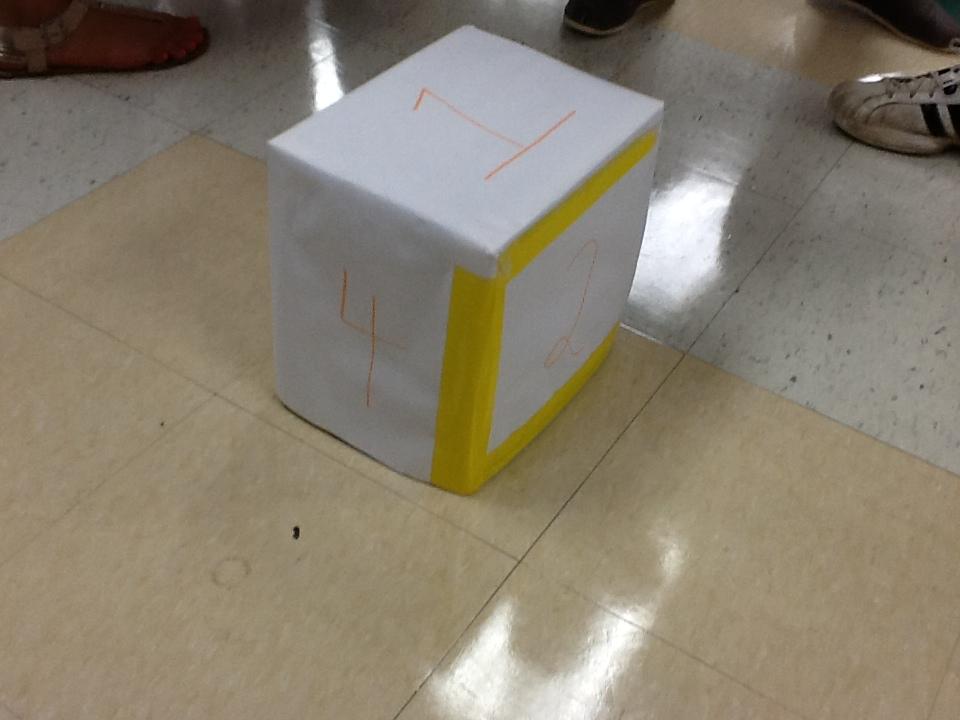
I always tell colleagues that the best things I learned about teaching I learned on Twitter. Recently, I tried out a an activity that was new to my classroom: The Subversive Lab Grouping Game. This activity inspired me to continue with the 'subversive' teaching through games on day two. This activity is one I have done in previous years, but it's been a few and now I have repurposed it based on my success with Frank Noschese's lab grouping game. This is called the Magic Number Cube, and it is a team-building activity that I picked up in the physics modeling workshop I took a few years ago. It's an activity that has students collaborating to think through a goal-less problem in order to learn numerous lessons about my class, including the process of arriving at consensus.
My colleague Don Pata and I have discussed in the past the factors which we find to lead most to student success in our modeling classrooms. It turns out that the classrooms with greatest student success are the classes where the students have the best ability to work together to arrive at consensus. In the modeling methodology of teaching science, teachers lead students through the modeling cycle. The modeling cycle requires students to develop mental models based on observations that can explain or predict patterns and relationships in physical situations. Students share their observations and data from experiments with each other through guided classroom discussions and must arrive at consensus based on the evidence to develop a model. Models are then deployed on novel situations and to solve new problems.
Without forming consensus, students leave holes in their understanding and questions unanswered about their observations or physical situations we've investigated as a class. This makes the development of a model unstable, and thus the deployment of an unstable model leads to unreliable problem-solving and understanding. This is the reason why forming consensus as a class is so important for students to hone as a skill in the classroom. That's why we go to the lengths to train students in the process of learning in this manner before letting them loose on the content in this way. If they are not well-prepared to learn in this setting of a modeling classroom, then it won't be as great a learning opportunity for them as it could be--and we want the best for our students--so, we have to get them the best opportunities.
The opening days of my class are spent on team-building, growing the classroom climate that fosters successful teamwork, and generating consensus friendly discussion. As I mentioned, the first day activity was a lab-grouping game, which was quite successful to communicate several messages to students about focusing on process and working as a team. The second day activity, the Magic Number Cube, continues in this same theme but with a slightly different focus in its message.
Here's how the activity works:
Students work in groups of four
A six-sided cube made out of cardboard and covered in blank printer paper (about the size of a basketball) sits on the floor
On five sides of the cube are written the numbers 1-5, just like a die
Students can observe the cube on all sides, up close, or from far away
The cube cannot be touched, moved, or flipped over
Students must determine what is on the bottom face of the cube, and what reasoning helped them arrive at their determination
Students then create a whiteboard with their group that displays what they think is on the bottom face of the cube and explains their reasoning
Once students have constructed their whiteboards, they will present their ideas to their classmates and discuss everyone's reasoning. This is a process that makes thinking visible to other students. After discussing the ideas of each group and giving students the opportunity to question one another's reasoning, we ask students to vote as a class on one idea that they can accept. We do this with a 'show of thumbs' where:
Thumbs Up = agree with the idea and reasoning
Thumbs Down = disagree with the idea and reasoning
Thumbs Sideways = could accept the idea but perhaps differ in reasoning
After an initial vote, we see where the class stands, give students a chance to ask additional questions, change their minds based on any newly shared information, and then revote. When the class arrives at consensus, they erase their whiteboards.
The importance of arriving at consensus is discussed with students; the process they just went through to arrive at consensus is made transparent by naming/describing the steps; and the activity is debriefed by students.
Students are really eager to find out what is on the bottom face of the cube, but it must be stressed to students that this activity is done to show how learning will look/feel in this class:
It can be frustrating not to know everything, sometimes; however, uncertainty helps us grow in our understanding
It is not about answers, it's about how you arrive at answers and solve problems
When we focus on answers, and not process, it leads to a fixed mindset
Fixed mindedness promotes worry about grades, being smart, and leads to self-limitations
Our class encourages growth mindset, where students can work to surpass their current knowledge and ability through teamwork, critical thinking, and practice
The process we used in this activity to arrive at consensus will be our most important learning tool
This activity is a very low-risk opportunity for classes to practice all the skills necessary to doing the model development cycle, whiteboarding, and arriving at class consensus. It was originally used as a get-to-know-you team-building activity when I first saw it; however, I wanted it to be more than just that. It has proven to be a thought-provoking activity to promote discussion and questioning in students as well as demonstrate model development and arriving at consensus.
One of the most insightful parts of this activity, and perhaps a subversive outcome, is observing the variety of ideas that students share about what might be on the bottom face. Student-thinking and lines of reasoning are two fascinating elements of education, and this activity illustrates those very well.
All too often, school is reduced down to answers. The focus on answers starts early in elementary school and 'programs' student thinking, which leads to a fixed mindset as students get older. The limitations of a fixed mindset are perhaps at the root of many of the challenges students experience in school, but this can all be overcome if the focus is shifted from answers to process, the mindset can become a mind shift. Students can begin to move toward a growth mindset and realize that their potential is up to them. Ultimately, isn't this a message we want students to take away from school and use in their future?
I can remember back to elementary school dinner table conversations with my parents and siblings, they even continued into middle and high school. The question was always the same, "What'd you learn at school today?" My responses evolved over time as a student and the level of detail seemed to diminish for some reason. Verbal pattern baldness, perhaps???
Now, looking back to those supper-side chats, I realize that they held a far greater function than I was able to see at the time. The question of "what did you learn in school today?" is really a motivation for a student to reflect on the day. As a teacher, I want my students thinking about my class after they leave. Reflection is something that I hope to foster in my students. But often times, students forget, just as I did at that time in my life, to stop and reflect on the school day. Thinking about what took place, what was memorable, or how the learning connected to outside life are typically low on the priority list and get overlooked.
It was not until this past summer, when I took the modeling workshop in chemistry (at Mansfield University in PA) that I really got a contextual understanding of the power of simple reflection. I decided that I was going to blog about the workshop every day and what I learned in the workshop session that day. It was an arduous process to blog every day for me, but I adapted and eventually completed my 15-day project to chronicle the #ModChem12 experience. As I read through my blog posts, and as I chat with others who have read them, I realize that those blog posts solidified my learning in that workshop. Those blogs helped me articulate my take-aways from the workshop and realize how it all went together. It's crystal clear to me, now, how important reflection is to the learning process and to active engagement.
As an homage to that timeless dinner table conversation starter, "What'd you learn in school today?" and motivated by my experience with daily blogging after class myself, I wanted to do a project this school year to get students reflecting on class in a digital way. I considered blogs, discussion boards, and chats; however, for a first crack at a project like this, I wanted it to be easily accessible to everyone. Two other considerations I had in developing this project included my nascent rethinking of homework (thanks @mpershan and @kellyoshea) and the 180 Photo Project by an outstanding science teacher in NYC, Frank Noschese. Frank's 180 project sought to document the entire school year in a photo-a-day reel. Thus, I give you my project for this school year--the #Tweet180Project.
This project seeks to continue those dinner conversations and have students answer the question "what'd you learn in school today?" in tweets each day. That's it. Simple objective; simple execution; simple motivation. The value of being able to answer that question, in 140 characters or less, can start a conversation, keep a conversation going, or illuminate a new conversation that needs to take place. The #Tweet180Project will encourage students to be succinct in their reflections and provide formative feedback to me in working with students in my teaching.
The project definitely has the overarching theme of "what'd you learn in school today?"but the exact iteration of that question may differ from day to day. Each day, I will list the question for students that the will answer. They include our class hashtag in their tweet and answer the question. Pretty straight-forward, right? I hope so. And I hope that this becomes a spark for student growth in reflective thinking.
Each day the Twitter task differs slightly, yet still keeps in theme with "what'd you learn in school today?"
On day 1, it was: tweet something memorable from class today.
On day 2, it was: tweet something unfamiliar from class today.
On day 3, it was: tweet something surprising from class today.
And so on, and so on it will go...
From time to time, I will try to aggregate example tweets along with the the task prompt and post them. At the end, I hope to have a full timeline of the school year from the student perspective. This will serve as a running record for students as well as to how their thinking progressed throughout the year. Our school has several initiatives going this year, including to get students writing as often as possible in all classes; incorporate collaboration, creativity, communication & critical thinking; make thinking visible; teach digital citizenship; and, to foster a growth mindset in students. The #Tweet180Project aims to target both the propagation of dinner-style "what'd you learn at school today?" questions as well as our building and district initiatives.
I'm really excited about the response so far to this project. Hundreds of tweets are going around each day so far, some including photos, about the topics. Igniting small conversations, questions, and good "chatter" about physics and chemistry. As time goes on, I imagine these will increase in quality and quantity. The #Tweet180Project is just one of many things I am looking forward to in my classroom this year with students.
It's going to be the best year ever!!
**For anyone who is interested in this project idea but perhaps does not use Twitter in class with students, this project resembles what my English teacher colleagues call 'quick writes' and can be done as short journal entries in a notebook at the end of each day. To maintain the concise nature of the Twitter approach, you can even consider putting a character or word limit on their quick writes if you chose to do them in notebooks. Make sure that the prompts honor the main objective of this project--"what'd you learn in school today?" Just find a way to share those ideas aloud among students so that it can become a conversation too.
At the start of the school year, I had plenty of motivation for creating a classroom brand, but had to devise how I
would implement my classroom brand in my physics classes and determine what it would require
to get students to buy in to the brand. The classroom brand had already been chosen, TeamPhysics, but without much of a background in
marketing, implementing the brand was a challenge. So, I looked at all that I knew of
successful branding campaigns and put pieces together from each to form the elements of my
classroom brand.
It required several steps to really engineer the brand
to start. From what I learned about branding my classroom, here's what
is important to do in order to get started:
Write your classroom experience sentence -
I thought of Dan Pink's 'What's Your Sentence?'
presentation on this. He challenges people to define their life's
accomplishments (what they want to be remembered for) in a single
sentence. I realized, after thinking about this, that most brands keep
it simple, like Nike's Just Do It. So, I needed a sentence for my
classroom. The sentence needed to answer the question: what do I want
my classroom to be known for after students leave? Once I had this
sentence, then I could go forward with the rest of the branding. After
all, isn't it the most important thing to know what a brand stands for?
Design a logo for your classroom brand -
Every good brand needs a logo. The visual
recognition alone is imperative to the branding concept. When I thought
of a brand, there were really two choices: an icon logo or a word logo.
For TeamPhysics, it seemed sufficient to use the word as the logo (like
Google does.) To make it stand out and be unique, I thought I would
craft the word TeamPhysics out of physics symbols.
Come up with a hashtag for your classroom brand -
If you're not using Twitter in your classroom,
then this step does not yet apply to you; however, if Twitter is part
of your educator world, then you need a hashtag for students to come
together about your brand and about your classroom on Twitter. Research
your ideas before making it official. Sometimes, hashtags have more than
one meaning or acronyms have significance in a foreign language, and
you don't want overlap or muddled conversations on Twitter. We went with
#TeamPhysics, but over time this was used by people around the world
who weren't associated with my class; so, next year I will choose
something different. Perhaps an acronym with a year (e.g., tmphys12) can
be your hashtag. Remember that social media can help extend the
classroom experience beyond the four walls of your room.
You need a mantra for your classroom brand -
Think of the short sub-sentences that companies have underneath their logo. Tumblr
has a good one: "follow the world's creators." This is something that
students can remember and recite to others about your classroom brand.
It helps build that abstract element of what the brand stands for. The
TeamPhysics mantra is "Challenge accepted."
Your classroom brand should embody student-developed norms and values -
Not
at all to be confused with classroom rules, norms and values are ideals
that students seek to have in their classroom community. Develop these
together in the first days of the school year and then promulgate them. A
good example of a norm from TeamPhysics refers to what happens after
whiteboard presentations or students volunteer. The norm is: everyone claps, and it's a golf clap.
These are those behaviors that everyone wants to have going on but
don't come from rules. Much like tipping a server at a restaurant is a
norm, not a rule.
Classroom brand paraphernalia -
Start
planning early to find out who your school or athletic department uses
to get t-shirts made. Have students participate in the design of the
shirts, choose colors, etc. Get them made as early as possible in the
year. Encourage everyone to get one, and, if you can, find grant money,
booster club or parent club support, to get everyone a shirt. You can
have special days where students where their shirts, like test days
(like game day support for a team.) It helps to promote the classroom
brand and unify the group.
Make your classroom brand ubiquitous to students -
Any
handout, assignment, or assessment that students receive from you
should have your classroom brand logo on it somewhere. Whenever you (or
your students) talk about your class, make sure everyone is passing the
pronoun test: do statements about the class contain "we" language or
not? Classroom culture is not about teacher vs. students; it's about us
together. Focus the language used in this way. Stop referring to your
class by its course catalog name and start referring to it by classroom
brand. Students don't "take physics with Mr. Abud" they are "a member of
TeamPhysics." And, when we had our cardboard boat races in the spring,
the programs all had "Presented by TeamPhysics" with our logo. It's
really the little things that make it work.
Obtain survey-based feedback on your classroom brand from students from time to time -
Just like corporate brands obtain feedback from consumers to see how
their brand is doing, it is important that students get feedback
opportunities that are risk-free where they can share ideas for making
the classroom even better. Anonymous surveys, class discussions, small
group discussions and whiteboard presentations are all possibilities for
obtaining this information.
TeamPhysics was one of the best ideas I have ever had
for building classroom culture and establishing the learning climate I
wanted to foster in my students. It fits with the way that I teach
science and my philosophy of education. It gives the students something
to be a part of and not merely feel they are just in another class. This
can be really helpful when the going gets tough. Since physics is
taught using the Modeling Method
we are doing a tremendous amount of student-centered activity in groups
as well as project-based learning. The atmosphere of the classroom is
that of a team, and needs to be just that, in order for Modeling
Instruction to work. Modeling Instruction doesn't work if you don't
build rapport and the fastest way to building rapport is to promote a
positive classroom culture.
The students really came
together around the classroom brand and talked it up so much and so
regularly that it did become something bigger than I alone could ever
have made it. The principal would comment to me about how he noticed
students regularly Tweeting about physics using the hashtag #TeamPhysics
and that they seemed to be genuinely interested in the notion of
'physics as sport.' It was rarely homework to Tweet about physics.
Instead, we would have #TweetYour______ Twitter activities during class,
where students would share pictures of their labs, whiteboards, or even
just their data. Also, we held class discussions, much like #scichat,
on Twitter during class and played Kelly O'Shea's whiteboard mistake game
using Twitter as well (#WhatsUpWithThatBoard.) Students outside of
class would post comments or questions about homework, share photos of
projects in the works, or just share links to physics related stuff they
saw outside of school or online. When the students started sharing on
their own volition about physics with the #TeamPhysics hashtag, I felt I
had accomplished something with the classroom brand.
To
round out our classroom culture, we had character building activities
during the year, opportunities for community service, and celebrations
of accomplishment.
The Rock, Paper, Scissors tournament
is a good example. This single elimination challenge of the classic game
has the winners of each round taking the losers with them to the next
round as their cheering squad. This is the "biggest fan" stipulation. If
you lose, you become the winner's biggest fan and cheer them on. By the
finals, the class is divided in half shouting and cheering on one or
the other student. There are plenty of character-building team-building activities out there. They take only a few minutes and can make the difference in sculpting your classroom culture from time to time.
In
December, we adopt a local family whose name has been submitted as
needing assistance for Christmas. The class divides up into groups and
organizes purchasing gifts and food for the entire family for Christmas.
Then, they have a wrapping party one day (complete with hot chocolate
and donuts) and then choose a few students to personally deliver the
gifts to the family. This is always a memorable opportunity for students
and makes the class seem to be more than just 'learning physics.'
Donut
holes or popcorn parties are easy to do, and they go well with
activities in class. For example, if you have presentations coming up
after a big project, get a bunch of popcorn for everyone to share and
eat while they observe the presentations. Putting this extra tidbit into
your classroom activities can make 'scary presentation time' into a
celebration of accomplishment.
When it all comes down
to it, there are so many activities and elements of the TeamPhysics
classroom that stem from the classroom branding idea. For me, the
classroom brand had to entail a sense of team, foster student-student
and teacher-student rapport, help extend learning beyond the school day,
and be something with which students could identify. Capitalizing on
the popularity of the #Team________ concept on Twitter, and leveraging
the power of branding, helped to create the classroom culture that I
always wanted. The reason I believe it was successful now, looking back,
is that everything I wanted my classroom to stand for was all
represented in one centralized abstract thing, the classroom brand. Once
your classroom brand takes off, other students and colleagues will
start to take note. It will bring positive attention to your students
and their classroom, which will reinforce the greatness of that
classroom culture.
 When students, parents, and educators alike hear the word "standardized" most think of a fill-in-the-ovals multiple-choice test that is viewed as a judgement of a student's academic worth. Though standardized tests have become a staple of U.S. education, they are neither the end, nor the means, of standards in education. The education reform of the past twenty years in the U.S. has sought not to implement standardized tests, but to ensure a standard education is accessible to all students everywhere. A standard, such as the gold standard in currency, is merely a frame of reference for comparison. It is an established norm against which other things of similar form can be equitably compared. In the case of currency, paper money was manufactured and could hold any denomination of the maker's choosing; however, comparing currency to a designated amount of gold ensured that a similar amount of paper or coin would always be the same no matter where it was tendered. For education, a set of curriculum standards assures that students are learning the same content in the same way, but necessarily with the same lessons. The idea is to ensure students all achieve the same academic end from their education independent of the instructional means. More simply, standards-based education is an agreed upon doctrine of what to teach and not how to teach.


.jpg)